Autonomous Vehicles – The Way Forward
by Ron Demcko, AVX Fellow, AVX Corporation
Featured Supplier
Featured Products
Related Resources
We live in what may prove to be the most exciting time in the history of electronics and the world – rapid
acceptance and expansion of electronics use in virtually every aspect of daily life. As a result, the world around
us offers totally new families of products which are more efficient, reliable, interactive and safer products than
most of us could have ever imagined. Nowhere is the trend more apparent that in the current transformation of the
automobile.
Figure 1: We live in what may prove to be the most exciting time in the history of electronics
and the world - Nowhere is the trend more apparent than in the current transformation of the automobile.
During most of our lives, vehicles have evolved from hand crafted classics controlled by cables and mechanical
systems to (ultimately) computer controlled self-thinking machines which cater to our safety, comfort and
productivity – in that order…… And if we ever wanted to change the priority of what a car delivered the user it
could be modified through software. The current state of autonomous cars is one with head winds coming from
regulatory and public acceptance issues rather than insurmountable technical problems. Given that the technology is
closer than the vast majority of the public realizes, it is worthwhile to step back and look at what autonomous
vehicles (AVs) have to offer, identify the headwinds to acceptance, and examine the impact hardware will play in
turning headwinds into resounding acceptance.
Mobility
Mobility is the kind of thing that is taken for granted - until it’s gone. Mobility is sometimes lost though a
driver’s inability to drive safely, issues of vehicle affordability, accessibility, and numerous other reasons. The
case for autonomous vehicles offers solutions to these problems.
- A fully autonomous car could safely transport passengers (or things) anywhere they (or a third party) desires
regardless of physical ability.
- Transportation affordability might well be improved through less fuel and time consumption, plus new concepts of
transportation sharing, or off-time leasing. Imagine a vehicle that transports family members as a primary task
and also earns income for its owners as an autonomous
taxi.
- AVs would reduce congestion though advanced route planning and optimization. Furthermore, there's the
possibility of convoying or platooning into "transportation trains" to save fuel and provide the flexibility of
routes without rails.
But perhaps safety is the most compelling reason behind autonomous vehicles. With approximately 90% of accidents
caused by human error, the advantages of intelligent vehicles are immediately apparent. Yet the concern over
autonomous vehicle safety is the topic that has the potential to slow acceptance of, or derail the technology
altogether.
Headwinds
Autonomous vehicles currently experience headwinds to adoption with respect to public acceptance, regulatory
institutions, legal liability, and the reliability of AVs.
Acceptance - It has been said that the autonomous car is the modern day version of a model T getting riders off
horses and into car seats. While that statement is hard to accept at first, informal polls of current acceptance
appear to be delineated by age and technical proficiency. Acceptance can be assumed to grow as more and more young
drivers are exposed to autonomous options (and elderly choose independence with autonomous cars vs. potentially no
mobility or dependence on others).
With acceptance nearly certain to expand, liability and regulatory complexity are the most serious remaining
issues.
Regulatory – Several vehicle classification questions exist. These range from concerns of consistent autonomous
vehicle performance when exposed to human driven vehicles in different road conditions, complex situations and
vehicle age. Additional questions arise regarding what regulations are adequate for autonomous vehicles to operate
at maximum efficiency yet
protect vehicles driven by humans (e.g., speed limits, lane limits, maximum convoy size etc.) Furthermore, what laws
must be enacted to deter hacking of autonomous vehicles?
Liability – Answering who is responsible in the case of an accident is an even more complex question. Does the
responsibility of an accident fall upon the person sitting in the driver seat, vehicle owner, OEM, software
designers or component suppliers? Regardless of where the liability falls, it’s in the best interest of everyone for
hardware to be designed to the highest level possible given the state of the art available.
Reliability - The automotive industry has taken exceptional steps to insure reliability in automobile electronics.
From an electronics supplier point of view – implementation of AEC Q200 has had enormous payback on electronic
reliability and performance in all areas of transportation electronics. Across the board acceptance of International
standards such as ISO26262 governing the safety of critical electronics is imperative in autonomous vehicles.
Emerging technology pioneered by leading component suppliers can complement the existing automotive specifications
and standards, and result in a new classification for extreme reliability components and design practice. This might
range from an attempt to reduce ECU count and implementation cost (thereby reducing the likelihood of EMI between
control processors and possibly even hacking entry points) through the use of multicore processors that can be
partitioned to perform certain tasks. Once completed the outcome of the tasks can be acted upon within another
portion of the processor core. As automotive grade microprocessors get more powerful, more tasks can be loaded upon
the microprocessor. This can ultimately improve processing time and reduce design complexity.
Passive components could play a major role in improving system reliability, especially considering that passives
dominate the component count on ADAS systems. For example, consider a mid-complexity ECU having 200 capacitors on
it. If next generation self-healing capacitors were used in the design, we have suddenly eliminated 200 potential
failure points in the circuit.
A second scenario might be the replacement of discrete inductor / capacitor based filters with integrated LC T
filters. In a T filter configuration scenario – two inductors and one capacitor could be replaced with a single
integrated filter package which is typically in an 0805 case size. The number of components are reduced, which
results in fewer possibilities for assembly induced defects - pick and place errors, damage, board flexure induced
failures, etc.
Solder process errors are reduced by a lower number of solder joints. Finally, the failure rate of the single
filter is equal to or better than the combination of discrete devices.
Five technology trends are dominating passive component evolution in the automotive sector. Each trend has a
meaningful impact on board level reliability. However, their impact on overall system reliability and performance is
extremely positive.
- Self- Healing Capacitors – AEC Q200 qualified capacitors now exist that recover from an induced
failure in a capacitive state. The capacitors continue operation as a capacitor indefinitely. These devices are an
enabling technology for failsafe power supplies and regulators within automobile (and avionic) circuits. AVX OxiCap® NbO Capacitors are self-healing. When subject to voltage
spikes or high current surges that can result in increased leakage current and slightly reduced capacitance,
OxiCap® capacitors will continue to function as a capacitor.
- Transient Capable Passives – Miniature, high Q, low value RF capacitors and inductors have
never fared well when exposed to ESD and other transient waveforms. A new material and manufacturing system has
been developed to create ESD capable inductors, capacitors and
filters. These devices have the potential to harden RF links and sensors throughout ADAS designs (e.g., GPS,
Radar, and Lidar). The importance of RF transient capable devices is realized, and pulse withstanding integration
capacitors have been developed across multiple dielectrics, case sizes, values and voltages. Pulse Capable
integration capacitors can be utilized on IR camera, stereo vision and lane departure / keeping modules to improve
assembly yields as well as improve system reliability.
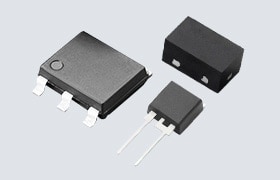
Figure 2: AVX TransGuard® Varistors are
rated to 150°C, capable of excellent performance in extreme temperatures under the hood in automotive
applications.
- Broad Band Passives - Broadband EMI
filters (for example offering -40dB attenuation across a 500 MHz wide RF spectrum) have been designed to
reduce EMI within mixed signal modules (RF:Digital, for example) and to eliminate board-to-board EMI concerns.
Next, Ultra Broad Band DC blocking capacitors provide maximum DC blocking
on future optical circuitry as well as AC coupling high frequency RF drivers.
- Harsh Environment Passives – a family of RF capacitor and inductors can expand and contract to
FR-4 (and other materials). These devices are capable of working in the continuously changing environment of
critical safety sensors. Additionally, a family of capacitors that is capable of extreme board flexure has been
created for both power and small signal applications.
Figure 3: AVX TransGuard® High Temperature Multi-Layer
Varistors are designed for under hood applications. Products have been tested, qualified, and specified to
150ºC. The MLV has EMI/RFI attenuation in the off state, so one can combine circuit protection and the EMI/RFI
attenuation in one device.
- Miniature Power Hold up Capacitors – Concern has been expressed over the effects of power
disruption to critical safety modules. A family of miniature SMT capacitors has been created which is rated in
both capacitance as well as joule hold up for ease of end design.
Conclusion
Autonomous vehicles are just a step away. Acceptance will continue to grow while regulatory and liability issues
are being nailed down. Electronic designs will migrate to the highest quality component and best design practice
across all critical ADAS control functions. Several manufacturers in both passive and semiconductor worlds are
already making enhanced reliability and functionality automotive grade components to address the extreme reliability
requirements of ADAS, and ADAS acceptance is a stepping stone to acceptance of fully autonomous vehicles. Design
topology will evolve and become streamlined to ensure that complex ADAS systems cannot be hacked and EMI does not
cross interfere with system functionality.
 Ron Demcko, writing for
Mouser Electronics, is currently an AVX Fellow and manages the TSG team at AVX corporate headquarters in Fountain
Inn, SC. His role centers on projects ranging from simulation models for passive components to product support, new
product identification, and applied development. Ron holds a B.S.E.E. from Clarkson College of Technology, Potsdam,
NY.
Ron Demcko, writing for
Mouser Electronics, is currently an AVX Fellow and manages the TSG team at AVX corporate headquarters in Fountain
Inn, SC. His role centers on projects ranging from simulation models for passive components to product support, new
product identification, and applied development. Ron holds a B.S.E.E. from Clarkson College of Technology, Potsdam,
NY.
 Perú
Perú